
The Indian Premier League is one of the most watched and unpredictable T20 tournaments in the world. Every season delivers unexpected results, where strong teams lose, and underdogs rise. Because of this uncertainty, many fans and analysts now rely on stats and data to understand match patterns instead of making random guesses. Numbers like team form, player performance, and venue records often reveal trends that are not obvious at first glance.
If you want to improve your predictions, using data is the smartest approach. It helps you look beyond star players and focus on real performance indicators. Simple insights such as recent results, batting strike rates, and bowling economy can make a big difference in reading a match correctly. When used properly, stats give you a clearer picture of what might happen, even in a fast format like IPL cricket.
Why Data Matters In IPL Predictions?
T20 cricket is fast. One over can change everything. But patterns still exist.
Data helps you:
- Understand team strengths and weaknesses
- Track player form
- Read pitch and venue behavior
- Compare past match results
Most top prediction models and analysts rely on historical stats and real time match data. Research papers on IPL prediction using machine learning also confirm that factors like toss, venue, and player form strongly influence results.
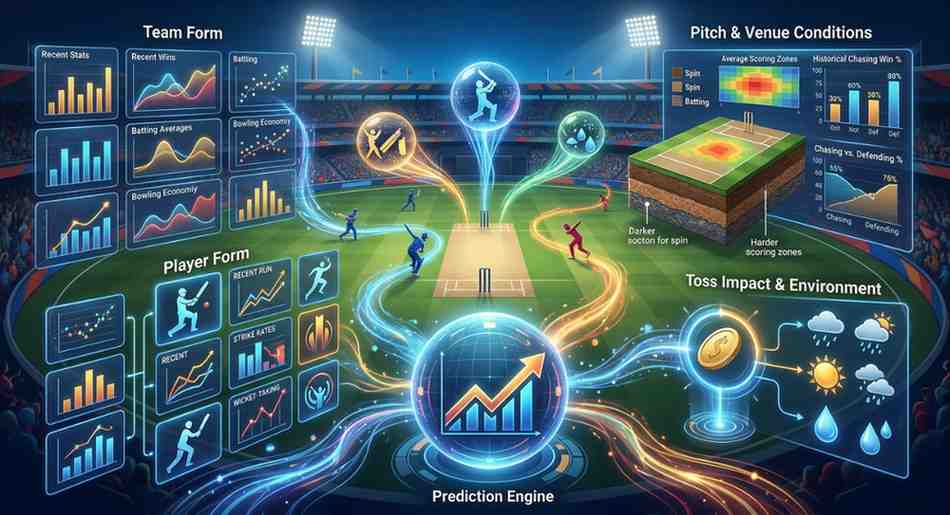
Key Factors That Affect IPL Match Outcomes
Before using stats, you need to know what actually impacts a match.
1. Team Form:
Check the last 5 matches:
- Winning streak matters
- Close losses also matter
- Net run rate shows dominance
2. Head to Head Record:
Some teams consistently dominate others.
Example:
- One team may have 15 wins out of 20 matches
- This shows a psychological edge
3. Pitch and Venue Stats:
Every ground behaves differently:
- Mumbai pitches favor batting
- Chennai pitches support spin
4. Toss Impact:
In many IPL matches:
- Teams prefer chasing
- Dew affects second innings bowling
5. Player Availability:
Injuries or player rotation can change the outcome.
How To Predict IPL Matches Using Stats And Data?
This is the core method. Follow these steps before every match.
- Check team performance. Look at wins, batting average, and bowling economy.
- Compare teams:
Team A: 6 wins, avg 32.5, eco 7.8
Team B: 4 wins, avg 28.1, eco 8.5
Insight: Team A is stronger. - Check player form. Focus on top batsmen, bowlers, and all rounders.
- Example:
Player 1: 210 runs, SR 150
Player 2: 6 wickets
Insight: One strong batter, one key bowler. - Study venue stats. Look at the average score and chasing success.
- Example:
Wankhede: 185 avg, 65 percent chasing
Chepauk: 160 avg, 45 percent chasing
Insight: Wankhede suits chasing, Chepauk suits batting first. - Check toss and conditions. Dew and night matches favor chasing teams.
- Combine all data. Do not rely on one factor.
- Final step: Use team stats, player form, venue trends, and conditions together for better prediction.
Advanced IPL Prediction Factors Using Data:
If you want a deeper analysis, use these:
- Check how a batsman performs against a specific bowler.
- Teams that score well in the first 6 overs often win.
- Matches are often decided in the last 5 overs.
- Higher dot balls create pressure.
Mistakes To Avoid While Predicting IPL Matches:
Many people make these errors:
- Relying only on big names
- Ignoring pitch conditions
- Not checking recent form
- Following public opinion blindly
Data should guide your decisions, not emotions.
What Research Says About IPL Prediction?
Studies from sports analytics and research platforms show:
- Machine learning models achieve 65 to 75 percent accuracy
- Toss and venue are among the top predictors
- Player form significantly impacts results
Source references:
- AIP Conference Proceedings on IPL prediction
- ResearchGate studies on cricket analytics
- Sports analytics blogs and data reports
This proves that data driven prediction is far more reliable than random guessing.
Can You Predict IPL Matches Accurately?
Yes, but not perfectly. The Indian Premier League is highly unpredictable, and even the best teams can lose on a given day. One over can change the game, and unexpected performances from players often turn matches around. That is why no prediction can be 100 percent accurate.
However, using stats and data does improve your chances. Instead of guessing, you rely on real trends and performance. A random prediction may be close to 50 percent accurate, while a data based approach can reach around 65 to 75 percent. It is not perfect, but it gives you a clear advantage over pure guesswork.
IPL Prediction Tips For Beginners:
If you are new to predicting IPL matches, starting with simple and practical steps can help you understand the game better and make smarter decisions over time.
- Start with basic stats like team wins, Net Run Rate (NRR), and top performers to understand which team is stronger
- Focus on recent performance by checking the last 4 to 5 matches instead of overall records
- Avoid using complex data in the beginning and keep your analysis simple
- Choose only 2 to 3 key factors, such as team form, pitch condition, and one key player
- Check the top players’ form by looking at runs scored, strike rate, and wickets taken
- Understand venue basics, as some pitches favor batting while others support bowlers
- Do not rely only on big names; always verify with recent performance data
- Track your predictions in a notebook or spreadsheet to improve over time
- Review your mistakes after each match and learn what went wrong
- Stay consistent, as regular analysis helps improve prediction accuracy
Fantasy Cricket vs Match Prediction:
If you are confused between fantasy cricket and match prediction, understanding the difference is important. Both involve analysis, but their goals and strategies are completely different.
| Factor | Fantasy Cricket | Match Prediction |
| Main Focus | Individual player performance | Overall team result |
| Goal | Score maximum fantasy points | Predict which team will win |
| Key Strategy | Select best performing players | Analyze team strength and match conditions |
| Important Data | Runs, wickets, strike rate, player roles | Team form, head to head, pitch, toss |
| Decision Making | Choose the captain and vice captain wisely | Compare both teams and pick the winner |
| Risk Level | High (depends on individual players) | Moderate (depends on team performance) |
| Example | Picking a batsman who may score big | Predicting Team A will beat Team B |
| Platforms | Dream11, My11Circle | General match analysis, stats based predictions |
| Skill Required | Player knowledge and form tracking | Understanding of overall game trends |
Fantasy cricket is about picking the right players, while match prediction is about choosing the winning team based on data and conditions.
Conclusion:
Predicting IPL matches using stats and data is about reading patterns, not guessing outcomes. Focus on team form, player performance, and venue trends. Combine multiple factors instead of relying on one stat.
Over time, your understanding improves. Your predictions become sharper. While no method is perfect, data driven analysis gives you a clear edge in understanding the game.
FAQs:
Team form and pitch conditions are the most important. They directly impact match performance.
No. Stats improve accuracy, but cannot guarantee results due to unpredictability in cricket.
Toss plays a major role, especially in night matches where chasing becomes easier due to dew.
Start with team form, player performance, and venue records. These are simple and effective.
Yes. Many models use historical data and achieve decent accuracy, but they still rely on real match variables.
