
The Indian Premier League is one of the most competitive cricket leagues in the world. Every season brings new teams, new players, and unpredictable results. Many fans try to predict match outcomes, but only a few understand the core concepts that actually improve accuracy.
If you want to become a better IPL predictor, you need more than guesswork. You need structure, observation, and consistency. This guide covers the basic concepts every IPL predictor should know to make smarter and more reliable predictions.
Why Understanding Basic Concepts Matters?
IPL matches are short. Momentum changes fast. A strong team can lose within a few overs. That is why prediction is not about picking big names. It is about reading conditions and patterns.
Many existing guides focus heavily on machine learning or complex models. While those are useful, they often ignore simple match level insights that experienced watchers use daily. This article fills that gap by focusing on practical and usable concepts.
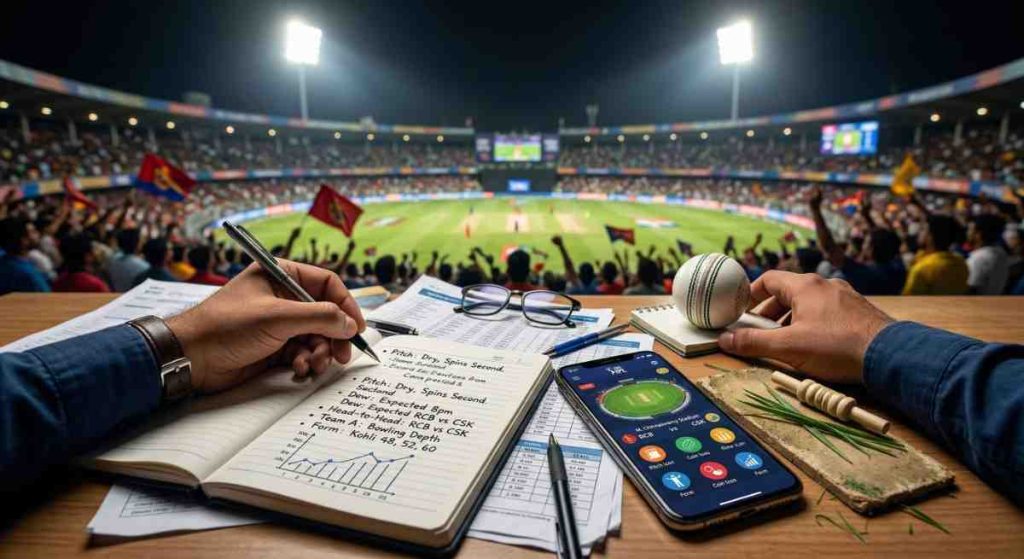
Basic Concepts Every IPL Predictor Should Know:
This is the core section of the guide. If you understand these concepts and apply them regularly, your predictions will improve over time.
1. Pitch Conditions Decide Everything:
The pitch is the first thing to check before any match.
Some pitches support batsmen. Others help bowlers. A slow pitch can reduce scoring, while a flat pitch can lead to big totals.
Key things to observe:
- Is the pitch dry or fresh
- Does it have cracks
- Is grass present
- Past match scores on the same ground
For example, Chennai usually has slower pitches. Mumbai often has batting friendly surfaces.
2. Team Combination and Balance:
A balanced team wins more matches than a team filled only with big names. You should always look at how well the team is structured. Check the number of all rounders, the variety in bowling options, and the mix of left and right hand batsmen. These small details often decide how flexible a team can be during pressure situations.
Teams that have reliable finishers and strong death bowling options usually perform better in close games. They can score quickly in the final overs and also defend totals with better control. This balance gives them an edge when the match goes down to the last few overs.
3. Player Form Over Reputation:
Big names do not guarantee performance. Always focus on recent form:
- Last 5 matches performance
- Strike rate for batsmen
- Economy rate for bowlers
A lesser known player in good form is often more valuable than a famous player struggling for runs.
4. Toss Impact on Match Result:
The toss plays a major role in IPL matches.
In many grounds:
- Teams prefer chasing
- The dew affects the second innings
- Bowlers struggle to grip the ball later
Check past data for each venue to understand if chasing teams have an advantage.
5. Weather and Dew Factor:
The weather can change the entire flow of an IPL match. You should always check conditions like dew in night games, humidity levels, and any chance of rain. These factors may seem small, but they can directly impact how teams plan their strategy.
Dew is especially important because it makes the ball wet and harder for bowlers to control. This usually gives an advantage to the team batting second, as chasing becomes easier under such conditions.
6. Head to Head Records:
Some teams perform better against specific opponents.
This is not luck. It is often due to matchups:
- Certain bowlers trouble specific batsmen
- Team strategies work better against certain lineups
Use head to head records as a supporting factor, not the main one.
7. Venue Specific Performance:
Every IPL venue behaves differently.
Some teams perform better at certain grounds due to familiarity.
Example insights:
- Home teams often know pitch behavior better
- Smaller grounds favor big hitters
- Large grounds help spinners and fielding teams
8. Match Situation Awareness:
Prediction does not stop once the match begins. In fact, live match reading is where many accurate predictions are made. You should closely observe how teams perform in different phases, like the power play, middle overs, and death overs.
A strong power play often gives a team early momentum and confidence. On the other hand, poor execution in the death overs can quickly shift the result, even if a team was in control earlier.
Key IPL Performance Data Example:
Below is a simple comparison of player performance factors that predictors often analyze:
| Player Type | Key Metric | Ideal Range | Impact on Prediction |
| Top Order Batsman | Strike Rate | 130 to 150 | Fast starts increase win chances |
| Middle Order Batsman | Average | 30 plus | Stability in pressure |
| Finisher | Strike Rate | 160 plus | Strong end overs |
| Fast Bowler | Economy Rate | Below 8 | Controls scoring |
| Spinner | Economy Rate | Below 7.5 | Key in the middle overs |
Common Mistakes IPL Predictors Make:
Even experienced predictors make errors. Avoid these to improve accuracy.
- Many people skip pitch analysis and rely only on teams.
- Popular opinion is often biased toward big teams.
- Cricket is a team game. One player rarely decides the match alone.
- Live prediction requires continuous observation.
Simple Step by Step Prediction Routine:
If you want a clear process, follow this routine:
- Before the match, check the pitch report
- Study the team lineup carefully
- Look at recent player and team form
- During the match, watch the power play closely
- Track bowling changes and captain’s decisions
- Observe key pressure moments
- After the match review, important turning points
- Compare your prediction with the actual result
- Learn from mistakes and improve
Consistency is what improves prediction skills over time
How Data And Logic Improve Prediction Accuracy?
Modern prediction methods use data, but basic logic still plays a major role.
You can combine both:
- Use stats for trends
- Use observation for real time decisions
- Compare past matches at the same venue
Research papers from platforms like IJRASET and ResearchGate show that data models improve prediction accuracy. However, human understanding of match conditions still remains critical.
Conclusion:
IPL prediction is not about luck. It is about understanding the game deeply. If you focus on pitch conditions, team balance, player form, and match situations, you will start seeing patterns. Over time, these patterns turn into better predictions.
Keep your approach simple. Stay consistent. Learn after every match. That is how experienced IPL predictors improve and stay ahead.
FAQs:
The pitch condition is the most important factor. It directly affects batting and bowling performance.
No, but it plays a strong role. Especially in matches where dew affects the second innings.
No. Stats are useful, but you must also consider current form and match conditions.
Very important. A balanced team performs better under pressure than a team with only star players.
Yes. Live prediction allows you to read match flow and adjust your understanding based on real time events.
